With all the polls for Israel’s 27 October election in, we built a forecast.
Forecast: most likely a deadlock. If every party keeps its word about whom it will and will not sit with, no majority forms in 87% of the simulations.
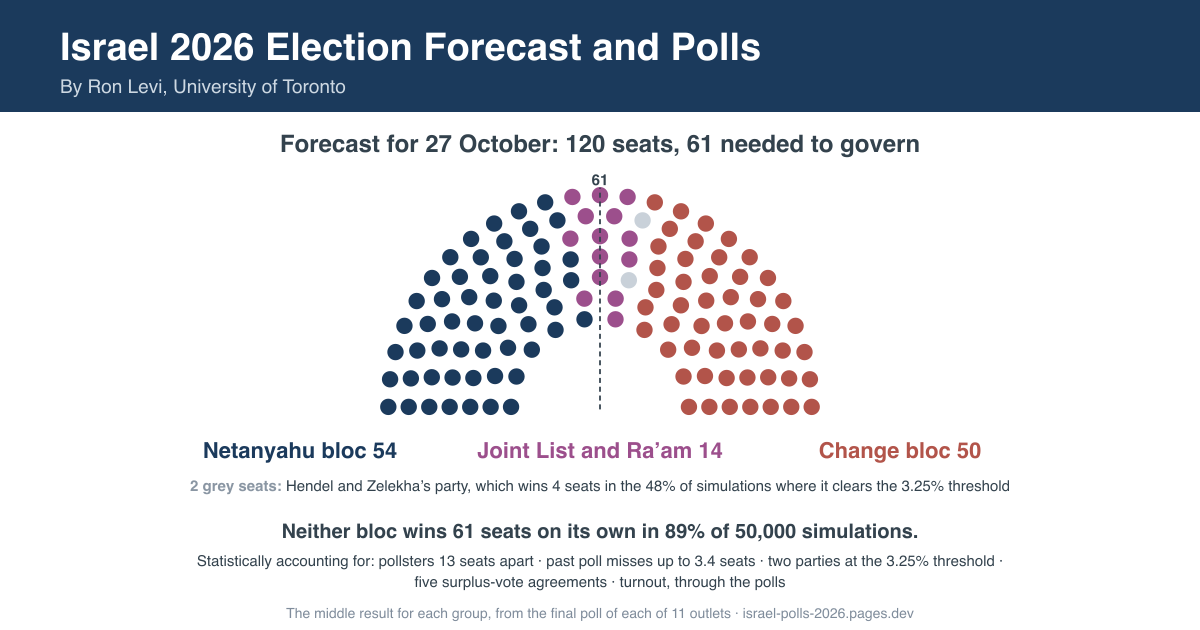
The forecast gives the Netanyahu bloc 54 seats, the Change bloc 50 and the Joint List and Ra'am 14. Ofer Winter's Amcha Israel, counted in the Netanyahu bloc, wins 4 seats when it gets in, and Hendel and Zelekha's party wins 4. When either stays out, it wins none, and its seats are shared among the other parties in proportion to their size.
In 90% of the simulations the Netanyahu bloc wins between 45 and 63, the Change bloc between 43 and 57, and the Joint List and Ra'am between 12 and 16.
The Netanyahu bloc wins 61 seats on its own in 11% of the simulations, and the Change bloc in under 1%. In the other 89%, neither bloc has 61 seats on its own.
The Change bloc and the Joint List and Ra'am together win 61 seats in 70% of the simulations. But Yashar, Together (Beyachad) and Yisrael Beiteinu have said they will not govern with those two parties or rely on their votes.
If every party keeps its word about whom it will and will not sit with in government, a majority forms in only 13% of the simulations, which include our estimates of polling error and turnout.
We simulated the election 50,000 times:
⇩ Download the poll database (CSV) - every headline poll in one file, one row per poll × party, rebuilt daily. Left out: where a pollster published more than one lineup on the same date (an alternative scenario such as a hypothetical merger, or a variant row we could not parse cleanly), the file includes only the headline poll, the same rule we apply in every chart, so its poll count matches the count in the masthead. Each figure comes from an individual poll by the named pollster, and every row records the pollster, who commissioned it, the source, and our verification level. Compiled by Ron Levi (University of Toronto) from those published polls; free to reuse with attribution (CC BY 4.0). The Download button under the table below instead saves only the rows you’ve filtered.
two_source_confirmed Confirmed against two independent sources - the strongest level (the N12/Midgam figures, cross-checked with Wikipedia).
primary_verified Independently checked, seat-by-seat, against the pollster’s own published release or a primary news report.
primary_confirmed Read directly from the pollster’s release.
aggregator_only Taken from Wikipedia’s poll-aggregation table, not independently re-checked.
conflict Sources disagreed; the value judged most reliable was kept and flagged here.
primary_manual Hand-entered by us from the pollster’s own report because it is newer than Wikipedia’s table (which lags the Hebrew press by a few days). Shown with an “awaiting confirmation” tag; it clears to two_source_confirmed automatically once Wikipedia carries the poll.
tracker_only Hand-entered from the seat figures posted by the @israel_elects account on X, the only source we found: the poll is not on Wikipedia and we did not find the pollster’s or outlet’s own report. Shown with an “@israel_elects only” tag; it clears to two_source_confirmed automatically if Wikipedia later carries the poll.
unconfirmed Not yet checked.
We record each poll exactly as its source published it, even where the seats don’t total 120: one Direct Polls survey (16 Jun) sums to 127 and one Lazar survey (11 Jun) to 117 (each is flagged in its notes column). The raw table is left unchanged. Before any average is taken, we rescale every poll to the 120 seats of the Knesset, so a source’s over- or under-count does not change the averages.
A single survey occasionally appears in the sources more than once. The same Channel 13 poll was logged first under one polling firm (Maagar Mochot) and later under another (Midgam) when the attribution was corrected, and some polls appear under two nearby dates (a date later revised, or a fieldwork-end date shown next to a publication date). After auditing every entry in July 2026, we adopted three rules so that no poll is counted twice in the averages:
How we identify a duplicate. Two entries are the same survey when they carry an identical seat breakdown from the same commissioning outlet. We match on the outlet that ordered the poll and its numbers, and ignore the polling firm’s name and the exact date, because both can differ across sources for one real survey.
Which copy we keep. We keep the best-sourced copy, the one with a real sample size and an independent, seat-by-seat check, in preference to a copy taken only from an aggregator, and drop the duplicate.
When we do not merge. Where identical numbers are far apart in time (weeks or more), we keep them as separate polls, because a race with little change can produce two matching results, and we flag them for a source check. We merge only where the evidence is unambiguous, and we note it in this key when we do not.
This site is an independent tracker of opinion polls for Israel’s 2026 Knesset election. We gathered the seat projections published by the major Israeli pollsters into one database, with tools for exploring them: trends, blocs, a coalition builder, and an “if the vote were held today” simulation.
Israeli pollsters publish their results (how many of the 120 seats each party would win) but not their raw surveys, and no official body collects them. We therefore aggregate published results (a “poll of polls”) and do not re-analyze raw survey data, which a meta-analysis would need and which pollsters do not release. Our main source is the Wikipedia poll-aggregation page (this build reads one specific revision), compiled together with pollsters’ own releases; we cross-check each figure against the pollster’s own release or the Hebrew press where possible, and label every number by how well it was confirmed. Some of them carry a second source beside that page. Most of that checking happens in Hebrew - 126 of 201 sources behind these figures are Israeli outlets (Zman Yisrael, N12, Channel 13, Kan, Maariv, Channel 14). The Israeli press carries a poll days before the aggregators do, and disagreements between sources are resolved there. Three disagreements this month were resolved from the pollster’s own Hebrew report: Kan’s seat graphic gave Shas 7 and United Torah Judaism 8 where the English table had them swapped; Channel 14’s write-up settled two more transposed pairs; and Ynet established that Ra’am’s primaries precede its reserved slots, not the reverse. Coverage is ~100 polls from 8 pollsters, checked for new polls automatically once a day. If a poll later disappears from Wikipedia, we keep our archived copy of it (flagged “archived”), so nothing we’ve captured is ever lost.
The Nowcast estimates the seats each party would win if the vote were held now and the polls were right, and it is not a forecast of the October result. The separate Forecast, whose numerical estimates were locked on 25 October, estimates the result on election day by adding how far the final polls missed at the last five Israeli elections. We do not grade or weight pollsters by track record, and we do not break results down by demographics, which would need the raw surveys. We show how the published numbers shifted, how much they disagreed, and which coalitions they implied. In each simulation run (one simulated election drawn from the polls and their likely errors), we let the polls for every party in a bloc miss in the same direction together, because polling errors are correlated across parties rather than independent; the coalition odds are therefore wider than they would be if each party’s error were independent. The full method, including this “correlated-error” term and a comparison of its bands with how far polls have actually missed, is under The nowcast simulation ↗.
Two. Likud held a members’ primary on 17 August 2026, and The Democrats held one on 20 July 2026 - the first fully online primary in Israeli politics. Every other party sets its list order another way: the leader decides in Yashar, Together, Yisrael Beiteinu and Otzma Yehudit; a party body votes in Religious Zionism, Hadash and Balad; and a rabbinical council approves the list in Shas, United Torah Judaism and Ra’am. Final slates were filed with the Central Elections Committee by 8 September 2026, when 38 lists were submitted. Each party’s slate and method is on the Candidate lists tab.
The election is on 27 October 2026, the end of the Knesset’s four-year term. The Knesset passed a dissolution bill and dissolved on 17 July 2026.
61 of the 120 Knesset seats. No single party wins a majority, so governing means assembling a coalition of parties that together hold at least 61.
We pool every major poll into a nowcast of where the final polls stood. The Netanyahu and Change blocs are close, and in most polls neither reaches 61 seats on its own (Nowcast and Coalition tracker tabs).
Most surveys put the Change bloc short of 61 seats without the two parties commonly called Arab-majority (Hadash-Ta’al and Ra’am), so few polls show such a government. Use the Coalition builder to test any combination against 61 seats.
All major Israeli pollsters (Midgam, Lazar, Kantar, Maagar Mochot, Direct Polls, Next Data, Filber, Yossi Tatika and others), taken from each firm’s own release and cross-checked against Wikipedia. Two trackers of Israeli polling are sources too: Israel Elects, which often carries a poll before Wikipedia does and is the first source for some of them here, and Knesset Jeremy, whose tables are a second check on many polls and head-to-heads. Every poll is also checked against the Central Elections Committee’s register, where the law requires each poll published during the campaign to be filed with its full results and method; one poll here comes from that register alone. Each poll’s notes name the source it came from.
A nowcast is an estimate, from the latest polls, of the seats each party would win if the vote were held today, rather than a forecast of the eventual October result.
The tracker does not predict who will become prime minister. The PM suitability tab tracks head-to-head “who is more suited to be prime minister” polling among the main contenders (Netanyahu, Eisenkot, Bennett), and the PM tab also carries a live prediction market on who forms the next government.
Built, analyzed and annotated by Ron Levi, University of Toronto (ron.levi@utoronto.ca), with Claude Code (Anthropic). The site compiles publicly available polls and conducts no polling of its own. It has no affiliation with any pollster or news outlet and no funding. To avoid counting a poll twice, we list only individual published polls (each pollster’s own survey) and leave out other aggregators’ and models’ averages. Bloc alignments (Netanyahu vs Change) describe the parties in this campaign and can change in another. Corrections, suggestions and advice are very welcome - please write to ron.levi@utoronto.ca.
Israel’s electoral threshold is 3.25% of the vote, worth roughly four of the 120 seats, and a party below it wins no seats. Pollsters publish seat projections rather than vote shares, so the threshold has already been applied before we see a number: a party that a pollster leaves out (or shows at zero) is one that pollster has judged to fall short. We do not apply the threshold ourselves. Our rule decides what to do when pollsters disagree about whether a party clears it.
We count a party in the two-week average if it passes either test: it is seated in at least half the window’s polls, or in at least half of the six most recent. A counted party’s average uses only the polls that seat it, so a firm that leaves the party out lowers the party’s chance of being counted without pulling its seats toward zero.
We added the second test on 30 July 2026, after the case of Yoaz Hendel’s list, which has run since 6 September with Yaron Zelekha’s as the Reservists and the Economic Party. The list crossed the threshold partway through that window: it appeared in 7 of the 17 polls then in range, under half, so it was dropped from every average, although three of the last four pollsters seated it at four or five. The first test counts how many polls seat a party and ignores which, so on its own it leaves a rising party out of the averages for up to two weeks. We keep the older test alongside because the second alone would admit a single fresh outlier: on that date Blue & White failed both, seated in 1 of those 17 polls and by no pollster since 16 July, and under both tests a single old poll does not add a party to the averages.
Adding a party changes every other party’s seats, because the projection is rescaled to total exactly 120: counting Hendel’s four seats shifted the blocs from 54/55/11 to 53/58/9, and neither bloc reaches 61 seats under either count. A party near the line can also enter or leave the averages between refreshes, and the change that follows in other parties’ seats is arithmetic, not a change in support.
We now apply the same rule in the nowcast simulation. Until then, membership in the simulation was judged after house effects (each firm’s persistent lean against the other firms) were evened out, so max(0, 0 − a negative lean) could produce a seat share for a party a pollster had placed below the threshold, which put Balad (seated by no pollster at all) and Blue & White into the simulation. We now judge membership on the raw published seats in every panel: a house effect can change a party’s seat number but not whether the party is counted as running.
Because we pool published results, each real survey must be counted once. The same poll can enter the data under different labels, and a poll counted twice shifts every average without any visible sign. Our audit of the full data in July 2026 found three ways a poll is duplicated:
We treat two entries as the same survey when they have an identical seat breakdown from the same commissioning outlet. The outlet that ordered a poll, together with its numbers, identifies it; the polling firm’s name and the exact date vary across sources and do not. We keep the better-sourced copy (a sample size, an independent check) and drop the duplicate; where identical numbers are far apart in time and the case is ambiguous, we keep both and flag them rather than guess. Before this audit, a poll strongly favouring the Change bloc was counted twice, which made the opposition’s lead look steadier than the once-counted data support.
A nowcast is an estimate of current opinion from current polls, as opposed to a forecast of the eventual result. We treat the recent polls as a snapshot of opinion and turn their disagreement into probabilities:
Each percentage is the share of the 10,000 runs in which an outcome occurred. We chose 10,000 runs because the figures are then stable to within about half a percentage point (the Monte-Carlo error is roughly √(p(1−p)/N) ≈ 0.3–0.5 pp); more runs would not change the headline, since the model’s assumptions contribute more of the uncertainty. A fixed random seed makes the numbers reproducible.
Why allied parties rise together - the “correlated-error” term. In each simulated election we shift every party a little away from its polled seats, because polls are never exact. Real misses come in groups: if ultra-Orthodox turnout is higher than the pollsters expected, Shas and United Torah Judaism both finish above their polls, since both depend on the same voters. Had we shifted each party independently, a gain for Shas would often be offset by a chance fall for United Torah Judaism, and the Netanyahu bloc’s total would vary too little between runs and look more certain than it is. We therefore let the parties within a bloc vary partly together, with a “within-bloc correlation” of 0.35. We set 0.35 by judgment; it was not measured from past Israeli elections.
Our simulation is a deliberately simple version of the Monte-Carlo approach that professional election forecasters use (FiveThirtyEight, for example, which popularised the distinction between a nowcast and a forecast). It omits the parts of those models that make them elaborate: weighting pollsters by track record, fitting the full party-by-party error-correlation matrix from past elections, calibrating the spread to how far polls have historically missed at this distance from election day, and blending in non-poll “fundamentals.” (The toggle at the top of the tab evens out each pollster’s house effect; it is on by default, so the headline figures are already adjusted, though only relative to the other firms.)
Assumptions and limits. The uncertainty reflects disagreement between published polls; we do not hold the pollsters’ raw data, so we cannot model each survey’s own sampling and weighting. The simulation is seat arithmetic: we count who could reach 61 seats, not who would agree to govern together (hence the separate columns with and without the parties commonly called Arab-majority). It is also a nowcast rather than an October forecast, and the result could differ from it as opinion changed before election day. The spread is built from how far apart this cycle’s polls are, which differs from how far polls miss on the day, so the figures are broad signals rather than exact odds.
The width of the bands against past polling misses. The simulated range for a bloc is much wider than the error in the final polls at recent elections. At the last five elections the final polls put the right bloc within 0.2, 1.1, 0.4, 1.3 and 3.4 seats of its result, a spread of about 1.7 seats, whereas the simulation gives the Netanyahu bloc a spread of about 7 seats, four times as much. Part of the difference is timing, because the simulation uses polls taken weeks before the vote rather than the last ones published. A larger part comes from the firms’ disagreement with each other, from which the spread is computed; that disagreement measures real uncertainty about current opinion rather than sampling noise, and we do not narrow it for the number of polls, because one firm’s house effect is not cancelled by another’s. The rest is the shared bloc shock, set at a correlation of 0.35 between any two parties in the same bloc, which widens the bloc totals by design. The bands are therefore cautious by construction and are not an estimate of how far the polls will turn out to have missed.
The nowcast estimates current opinion. The forecast estimates the result on election day, and its figures appear in the gap between the pollsters panel in the Nowcast. We start from the same seat totals as the scoreboard, so the two agree by construction, and add three sources of error: the uncertainty in the current level, how far opinion has drifted over a period of this length in this campaign, and how far the final polls missed at the last five Israeli elections (between 0 and 3.4 seats on the Netanyahu bloc, and in the same direction four times out of five).
Our treatment of the first source of error is a judgement. Eight pollsters have published in the last fortnight, and they are about 4.9 seats apart on the Netanyahu bloc, from the high fifties to the low sixties at one end and the high forties at the other. Until 9 October 2026 we divided that spread by the square root of the number of pollsters, the usual standard error of a mean, which reduced it to 1.7 seats. That division measures how precisely the average of these eight is known. A forecast needs how far the election will fall from that average, and the two are equal only if each pollster’s difference from the average is an independent error that cancels in the average. Past elections suggest otherwise: the final polls missed the same bloc in the same direction at four of the last five elections, an error the pollsters share rather than eight unrelated ones. We now use the full spread, which widens the range and raises the chance that the Netanyahu bloc reaches 61 seats from about 2% to about 22%.
Using the full spread errs towards caution. The five-election error was measured on poll averages, so it already contains some of the same disagreement between pollsters, and using both counts a little of it twice. Eight pollsters in one campaign are too few to estimate how strongly their leans are correlated, and without that estimate the choice is a judgement.
The data change every day, so a citation needs to name the day; this citation names the last poll included in the build:
Levi, Ron. Israel 2026 Election Forecast and Polls. University of Toronto. Includes polls to 23 October 2026. https://israel-polls-2026.pages.dev/ (accessed [your date]).
Released under CC BY 4.0, so it may be reused, redistributed and built on, including commercially, as long as it is credited. The downloadable CSV carries the same credit on every row, in its compiled_by, source_dataset, source_url and license columns, so a copy of the file stays attributed wherever it is copied.
When the votes are counted, the 120 seats are shared out in proportion to each list’s share, and the division never comes out even: every list is left with votes too few for another seat. In a surplus-vote agreement, two lists agree before polling day to have those leftovers added together. If the combined total is enough for one more seat, that seat goes to whichever of the two is closer to earning it, so a pair can take a seat that neither would have taken alone. The agreements are worth a seat or two across the whole Knesset, and nothing to a pair in which either partner finishes below the threshold. Each party may pair with one other.
Five pairs signed, none of them across the two blocs; every deal, its date and its source are on the surplus-vote agreements page, which also lists who went unpaired. Filing closed at the Central Elections Committee at noon on 16 October, so these five are the set that will count on the night.
Our numbers are the pollsters’ own seat figures, averaged and rounded to 120; that rounding is arithmetic, not the election’s allocation. A bloc shown a seat short could reach 61 seats on the night without any poll having been wrong. A partner who finishes below the threshold contributes nothing.
Two rules govern which polls enter an average. First, we list individual published polls only: other aggregators’ and models’ averages are excluded, because pooling an average of polls with the polls it already contains counts the same surveys twice. Second, a poll has to be sourced well enough to check. Where it is not, we record the figures and the reason and leave them out of the averages rather than dropping them without notice, so that the data list what they omit instead of implying they are complete.
Holding an item off is not a judgment that its numbers are wrong. Each is recorded in data/held_off.csv with its reason, so it can be added to the counted data once the missing source appears. The DRI poll of 7 September was held off until 24 September and now counts, with its sourcing described beside its figures.
For the seats-over-time line we pool every pollster’s published polls into one curve with a Gaussian kernel (nearby polls count more); a model-based (Kalman) option smooths the same series as election forecasters do. The shaded 95% band is computed from how much the polls near each date disagree, so it is wider where polls are fewer. A house effect is a firm’s persistent difference from the consensus of all pollsters; “evened out” means we subtract that difference before pooling, and we compute the band from the raw spread so that the adjustment never overstates precision. We measure the difference, not its cause. Each firm’s current house effect per party appears beside the chart on The parties.
For Co-movement & factor structure (Dive into the data), the matrix gives the correlation between two parties’ seat series across polls; we apply principal-component analysis to the standardized (and compositionally transformed) series and report a range for the share of shared movement, because that share changes with the choice of method. For Challenger parties we use fuzzy-set Qualitative Comparative Analysis (Ragin): each party’s membership in “large” is calibrated from its recent seats, and we report which combinations of traits (newly formed, centrist) occur together with size, with consistency and coverage in the footnote. For Bargaining power (Coalition builder) we use the Banzhaf index, which counts, across every possible coalition and with no regard to political compatibility, how often a party’s seats take a group that is short of 61 seats up to 61 seats; a second column, If pledges over whom to partner with are kept, repeats the count with only the coalitions consistent with the publicly ruled-out pairings. The live figures and fuller notes for each analysis appear beside it.
polls (one row per poll × party). To start, click one of the grey example buttons below to run it, then edit it. (For yes/no fields, write scenario = false.)polls - one row per poll × party. Booleans: scenario = false.The count so far: 100.0% of polling stations counted at 00:01, 30 Oct Israel time. On those ballots the Netanyahu bloc has 44.0% of the vote and 53 seats, the Change bloc 37.8% and 48 seats, and the Joint List and Ra’am 14.7% and 19 seats; Likud has 20.5% and Yashar 16.1%. The double-envelope ballots (soldiers, diplomats, hospitals, prisons) are counted last. The Committee expects more than half a million of them, roughly a dozen seats’ worth, and in 2021 and 2022 one seat changed each time (United Torah Judaism to Yisrael Beiteinu in 2022, Ra’am to Meretz in 2021). The exit polls: at 22:00 the three main channels put the Netanyahu bloc at 50 seats, the Change bloc at 52 to 53 and the Joint List and Ra’am at 17 to 18, with Likud first on 24 to 25 and Yashar second on 21 to 23. The channels’ latest estimates put the blocs at 52, 49 and 19 on Channel 12 at 02:19; 51, 51 and 18 on Kan 11 at 01:40; 51, 51 and 18 on Channel 13 at 01:00.
The site’s previous forecast and nowcast were locked on 25 October 2026. They were built from the final polls, the last of which were published on 23 October, and they stay as they were on that date so they can be compared against the results. The forecast · The nowcast
We simulated the election 50,000 times, starting from each outlet’s final poll. In 89% of those runs, neither bloc won 61 seats on its own. The Netanyahu bloc won 61 on its own in 11%, and the Change bloc in under 1%. The Change bloc together with the Joint List and Ra’am won 61 in 70%.
While we published a nowcast for each party from June 2026 until the election, updated as new polls came in (the most recent nowcast ↗), we forecast seats for the three blocs, so the forecast column is blank for the parties. Its three figures add to 118, not 120. The other seats went to the Reservists (Hendel and Zelekha), who were in neither bloc: they cleared the threshold in 48% of the runs and averaged 2 seats. Each bloc’s middle result also comes from that bloc’s own ranking of the runs, so the three need not add to 120.
How was this forecast made? See the full forecast and its method ↗
| Count so far share of the vote (seats in brackets) 100.0% of polling stations double-envelope ballots being added 00:01, 30 Oct Israel time | Exit polls, 22:00, pooled average of Channel 12, Kan 11, Channel 13, Channel 14, Channel 16, i24NEWS | Our forecast, locked on 25 October 2026 middle result (90% range), from 11 outlets’ final polls | |
|---|---|---|---|
| Netanyahu bloc | 44.0% (53) | 53 (50 to 60 across channels) | 54 (45 to 63) |
| Change bloc | 37.8% (48) | 50 (43 to 53 across channels) | 50 (43 to 57) |
| Joint List and Ra’am | 14.7% (19) | 17 (16 to 18 across channels) | 14 (12 to 16) |
| Likud | 20.5% (27) | 26 (24 to 30 across channels) | |
| Yashar | 16.1% (21) | 21.2 (19 to 23 across channels) | |
| Together | 9.3% (12) | 13.2 (11 to 15 across channels) | |
| Joint List (Hadash-Ta'al-Balad) | 8.8% (11) | 10.2 (9 to 11 across channels) | |
| The Democrats | 6.4% (8) | 9.3 (9 to 10 across channels) | |
| Yisrael Beiteinu | 5.9% (7) | 6.5 (4 to 9 across channels) | |
| Ra'am | 5.9% (8) | 6.7 (5 to 7 across channels) | |
| Shas | 5.3% (6) | 7.3 (6 to 9 across channels) | |
| United Torah Judaism | 5.5% (7) | 6.7 (6 to 7 across channels) | |
| Otzma Yehudit | 5.7% (7) | 6.7 (6 to 7 across channels) | |
| Religious Zionism-Zehut | 5.1% (6) | 6.3 (6 to 7 across channels) |
The pooled figure is the plain average of the channels’ 22:00 exit polls, with their spread in brackets where they differ. It includes every channel, as our forecast included the final polls those channels commissioned; unticking the box in the column heading keeps only Channel 12, Kan 11 and Channel 13. Those three have been about equally accurate since 2006, missing by about one seat per party, and because they miss together, averaging them narrows the error only a little: in the nine elections from 2006 to 2022 the 22:00 samples missed a bloc by about 2 seats on average and by up to 5. Channel 14, Channel 16, i24NEWS have no such record to weight them by; each channel’s figures are shown on the results page.
An exit poll is a sample of voters leaving the booth, taken until about 20:00, two hours before the polls closed; the count replaces it. The channels’ later releases are their own updated estimates, not fresh samples: in 2020 and 2022 the post-midnight updates included counted polling stations, and the channels do not say what goes into each update, so we report the updates apart from the 22:00 exit polls.
The count is the Central Elections Committee’s, relayed by votes26.com within minutes of each file the Committee publishes (the file’s hash is recorded with each capture); the Committee’s own site refuses connections from outside Israel. Early files over-represent some towns, so the shares shift as more stations come in. Seats appear once most polling stations are counted; the official seats replace them when the Committee publishes its result.
We collected every published seat poll for Israel’s 2026 Knesset election, 311 polls from 11 pollsters, and recorded for every figure its source and how far we have checked it. The whole collection is free to download. Israeli law barred new polls from 24 October, so the polls in the collection are the last ones published before the vote.
Averaged over the final two weeks, with each pollster’s lean removed, the polls give Likud 22 seats and Yashar 22, followed by Together with 13. The Joint List and the Democrats have 9 each, and Otzma Yehudit, Shas, United Torah Judaism and Yisrael Beiteinu have 8 each. Religious Zionism has 7 and Ra'am 6.
We simulated the election 50,000 times from the final poll for each of 11 outlets, from nine pollsters, and statistically estimated the gap between the final polls and the results in Israel’s last five elections, how far apart this year’s pollsters are, and how often each small party near the 3.25% threshold gets in. Turnout is included through each poll’s own estimate of who will vote and through those past gaps. We also applied the five surplus-vote agreements the parties signed, approximately, because the agreements work on votes and the polls give seats. The forecast gives the Netanyahu bloc 54 seats, the Change bloc 50 and the Joint List and Ra’am 14. In 89% of the simulations, neither bloc reaches the 61 seats needed to govern on its own. The full forecast ↗

The eleven final polls, from nine pollsters, put the Netanyahu bloc between 48 and 62 seats. Lazar’s final poll for Maariv gives it 48 seats, as does Lazar’s final poll for Walla. Over the campaign, Lazar has put Likud about 3 seats below the average of all pollsters. Next Data’s final poll for Channel 14 gives the Netanyahu bloc 62, and over the campaign Next Data has had Likud polling about 8 seats above the average. Our forecast’s middle result for the Netanyahu bloc is 54 seats, which accounts for our statistical estimate of how final polls have compared to the results of past elections.
| Pollster | For | Date | Netanyahu bloc | Change bloc | Joint List and Ra’am |
|---|---|---|---|---|---|
| Lazar | Maariv | 22 Oct | 48 | 54 | 14 |
| Lazar | Walla | 19 Oct | 48 | 54 | 14 |
| HaMadad | Channel 13 | 23 Oct | 50 | 54 | 16 |
| Kantar | Israel Hayom | 22 Oct | 50 | 52 | 14 |
| Kantar | Kan 11 | 23 Oct | 50 | 52 | 14 |
| Midgam | Channel 12 | 23 Oct | 50 | 56 | 14 |
| Yossi Tatika | Zman Yisrael | 22 Oct | 51 | 51 | 14 |
| Maagar Mochot | Channel 16 | 22 Oct | 52 | 50 | 14 |
| Direct Polls | i24 News | 22 Oct | 59 | 47 | 14 |
| DRI Research Institute | own release | 21 Oct | 60 | 47 | 13 |
| Next Data | Channel 14 | 22 Oct | 62 | 44 | 14 |
All the polls we collected are in one download: 4,190 rows, one for each party in each poll, from 306 polls by 11 pollsters since January 2026. Every row records who ran the poll, who published it, a link to the source, and how far that figure has been checked; we read 53% of the rows at the pollster’s own report rather than taking them from the aggregation page. We kept the whole series rather than only the latest average, so a researcher can follow how a party’s standing changed week by week through the campaign, and how far the pollsters differed on the same date. The file is rebuilt daily and free to reuse with credit (how to cite ↗).
The count so far: 100.0% of polling stations counted at 00:01, 30 Oct Israel time. On those ballots the Netanyahu bloc has 44.0% of the vote and 53 seats, the Change bloc 37.8% and 48 seats, and the Joint List and Ra’am 14.7% and 19 seats; Likud has 20.5% and Yashar 16.1%. The double-envelope ballots (soldiers, diplomats, hospitals, prisons) are counted last. The Committee expects more than half a million of them, roughly a dozen seats’ worth, and in 2021 and 2022 one seat changed each time (United Torah Judaism to Yisrael Beiteinu in 2022, Ra’am to Meretz in 2021). The exit polls: at 22:00 the three main channels put the Netanyahu bloc at 50 seats, the Change bloc at 52 to 53 and the Joint List and Ra’am at 17 to 18, with Likud first on 24 to 25 and Yashar second on 21 to 23. The channels’ latest estimates put the blocs at 52, 49 and 19 on Channel 12 at 02:19; 51, 51 and 18 on Kan 11 at 01:40; 51, 51 and 18 on Channel 13 at 01:00.
The site’s previous forecast and nowcast were locked on 25 October 2026. They were built from the final polls, the last of which were published on 23 October, and they stay as they were on that date so they can be compared against the results. The forecast · The nowcast
We simulated the election 50,000 times, starting from each outlet’s final poll. In 89% of those runs, neither bloc won 61 seats on its own. The Netanyahu bloc won 61 on its own in 11%, and the Change bloc in under 1%. The Change bloc together with the Joint List and Ra’am won 61 in 70%.
While we published a nowcast for each party from June 2026 until the election, updated as new polls came in (the most recent nowcast ↗), we forecast seats for the three blocs, so the forecast column is blank for the parties. Its three figures add to 118, not 120. The other seats went to the Reservists (Hendel and Zelekha), who were in neither bloc: they cleared the threshold in 48% of the runs and averaged 2 seats. Each bloc’s middle result also comes from that bloc’s own ranking of the runs, so the three need not add to 120.
How was this forecast made? See the full forecast and its method ↗
| Count so far share of the vote (seats in brackets) 100.0% of polling stations double-envelope ballots being added 00:01, 30 Oct Israel time | Exit polls, 22:00, pooled average of Channel 12, Kan 11, Channel 13, Channel 14, Channel 16, i24NEWS | Our forecast, locked on 25 October 2026 middle result (90% range), from 11 outlets’ final polls | |
|---|---|---|---|
| Netanyahu bloc | 44.0% (53) | 53 (50 to 60 across channels) | 54 (45 to 63) |
| Change bloc | 37.8% (48) | 50 (43 to 53 across channels) | 50 (43 to 57) |
| Joint List and Ra’am | 14.7% (19) | 17 (16 to 18 across channels) | 14 (12 to 16) |
| Likud | 20.5% (27) | 26 (24 to 30 across channels) | |
| Yashar | 16.1% (21) | 21.2 (19 to 23 across channels) | |
| Together | 9.3% (12) | 13.2 (11 to 15 across channels) | |
| Joint List (Hadash-Ta'al-Balad) | 8.8% (11) | 10.2 (9 to 11 across channels) | |
| The Democrats | 6.4% (8) | 9.3 (9 to 10 across channels) | |
| Yisrael Beiteinu | 5.9% (7) | 6.5 (4 to 9 across channels) | |
| Ra'am | 5.9% (8) | 6.7 (5 to 7 across channels) | |
| Shas | 5.3% (6) | 7.3 (6 to 9 across channels) | |
| United Torah Judaism | 5.5% (7) | 6.7 (6 to 7 across channels) | |
| Otzma Yehudit | 5.7% (7) | 6.7 (6 to 7 across channels) | |
| Religious Zionism-Zehut | 5.1% (6) | 6.3 (6 to 7 across channels) |
The pooled figure is the plain average of the channels’ 22:00 exit polls, with their spread in brackets where they differ. It includes every channel, as our forecast included the final polls those channels commissioned; unticking the box in the column heading keeps only Channel 12, Kan 11 and Channel 13. Those three have been about equally accurate since 2006, missing by about one seat per party, and because they miss together, averaging them narrows the error only a little: in the nine elections from 2006 to 2022 the 22:00 samples missed a bloc by about 2 seats on average and by up to 5. Channel 14, Channel 16, i24NEWS have no such record to weight them by; each channel’s figures are shown on the results page.
An exit poll is a sample of voters leaving the booth, taken until about 20:00, two hours before the polls closed; the count replaces it. The channels’ later releases are their own updated estimates, not fresh samples: in 2020 and 2022 the post-midnight updates included counted polling stations, and the channels do not say what goes into each update, so we report the updates apart from the 22:00 exit polls.
The count is the Central Elections Committee’s, relayed by votes26.com within minutes of each file the Committee publishes (the file’s hash is recorded with each capture); the Committee’s own site refuses connections from outside Israel. Early files over-represent some towns, so the shares shift as more stations come in. Seats appear once most polling stations are counted; the official seats replace them when the Committee publishes its result.
| Party | Channel 12 | Channel 12 (estimate 22:30) | Channel 12 (estimate 02:15) | Channel 12 (estimate 02:19) | Kan 11 | Kan 11 (estimate 23:00) | Kan 11 (estimate 01:40) | Channel 13 | Channel 13 (estimate 22:45) | Channel 13 (estimate 01:00) | Channel 14 | Channel 14 (estimate 00:35) | Channel 16 | i24NEWS | Final polls, all outlets |
|---|---|---|---|---|---|---|---|---|---|---|---|---|---|---|---|
| pollster | Midgam (Mano Geva) | Midgam (Mano Geva) | Midgam (Mano Geva) | Midgam (Mano Geva) | Kantar (Dudi Chassid) | Kantar (Dudi Chassid) | Kantar (Dudi Chassid) | HaMadad (Shmuel Rosner) | HaMadad (Shmuel Rosner) | HaMadad (Shmuel Rosner) | Filber (Shlomo Filber) | Filber (Shlomo Filber) | Maagar Mochot (Yitzhak Katz) | Direct Polls (Zuriel Sharon) | |
| Likud | 24 | 24 | 27 | 27 | 25 | 25 | 27 | 25 | 25 | 27 | 30 | 31 | 25 | 27 | 17 to 30 |
| Yashar | 22 | 22 | 21 | 21 | 21 | 21 | 21 | 23 | 23 | 22 | 19 | 20 | 22 | 20 | 20 to 23 |
| Together | 12 | 12 | 12 | 12 | 14 | 13 | 12 | 14 | 13 | 13 | 11 | 11 | 13 | 15 | 9 to 15 |
| Joint List (Hadash-Ta'al-Balad) | 11 | 11 | 11 | 12 | 10 | 11 | 11 | 10 | 11 | 11 | 10 | 11 | 11 | 9 | 8 to 9 |
| The Democrats | 9 | 10 | 9 | 9 | 10 | 10 | 10 | 9 | 9 | 9 | 9 | 9 | 10 | 9 | 8 to 10 |
| Yisrael Beiteinu | 9 | 8 | 8 | 7 | 8 | 8 | 8 | 7 | 7 | 7 | 4 | 0 | 6 | 5 | 5 to 9 |
| Ra'am | 7 | 7 | 7 | 7 | 7 | 7 | 7 | 7 | 7 | 7 | 7 | 7 | 5 | 7 | 5 to 7 |
| Shas | 8 | 8 | 7 | 7 | 6 | 6 | 6 | 6 | 6 | 6 | 9 | 10 | 7 | 8 | 7 to 9 |
| United Torah Judaism | 6 | 6 | 6 | 6 | 6 | 6 | 6 | 7 | 7 | 6 | 7 | 7 | 7 | 7 | 7 to 8 |
| Otzma Yehudit | 6 | 6 | 6 | 6 | 7 | 7 | 6 | 6 | 6 | 6 | 7 | 7 | 7 | 7 | 7 to 9 |
| Religious Zionism-Zehut | 6 | 6 | 6 | 6 | 6 | 6 | 6 | 6 | 6 | 6 | 7 | 7 | 7 | 6 | 6 to 9 |
| Netanyahu bloc | 50 | 50 | 52 | 52 | 50 | 50 | 51 | 50 | 50 | 51 | 60 | 62 | 53 | 55 | 48 to 62 |
| Change bloc | 52 | 52 | 50 | 49 | 53 | 52 | 51 | 53 | 52 | 51 | 43 | 40 | 51 | 49 | 44 to 56 |
| Joint List and Ra’am | 18 | 18 | 18 | 19 | 17 | 18 | 18 | 17 | 18 | 18 | 17 | 18 | 16 | 16 | 13 to 16 |
| Exit poll, 22:00 | Netanyahu bloc | Change bloc | Joint List and Ra’am | Its final poll: Netanyahu bloc | Change bloc | Joint List and Ra’am | Pollster, date |
|---|---|---|---|---|---|---|---|
| Channel 12 | 50 | 52 | 18 | 50 | 56 | 14 | Midgam, 23 Oct |
| Kan 11 | 50 | 53 | 17 | 50 | 52 | 14 | Kantar, 23 Oct |
| Channel 13 | 50 | 53 | 17 | 50 | 54 | 16 | HaMadad, 23 Oct |
| Channel 14 | 60 | 43 | 17 | 62 | 44 | 14 | Next Data, 22 Oct |
| Channel 16 | 53 | 51 | 16 | 52 | 50 | 14 | Maagar Mochot, 22 Oct |
| i24NEWS | 55 | 49 | 16 | 59 | 47 | 14 | Direct Polls, 22 Oct |
| Our forecast, middle result (locked on 25 October 2026) | 54 | 50,000 simulations from each outlet’s final poll | |||||
In the nine elections from 2006 to 2022, the 22:00 samples missed a party’s seats by 0.9 seats on average, with single misses of up to 7 seats. The larger misses were at the 3.25% threshold: in 2013, 2019, 2021 and 2022 a channel showed a party in or out and the count went the other way. The bloc error ranged from -5 to +2 seats across those elections, with no consistent lean to either side.
The Central Elections Committee publishes a running count through the night and the days after, with the double-envelope ballots (soldiers, diplomats, hospitals, prisons) counted last. The Committee expects more than half a million of those this time, against about 460,000 in 2022 and 428,000 in 2021; in both years their count changed one party’s seats by one (United Torah Judaism 8 to 7 and Yisrael Beiteinu 5 to 6 in 2022, Ra’am 5 to 4 and Meretz 5 to 6 in 2021). The official result is due within eight days of the election. The table gives the count as it stands, and the official seats once they are published.
Each figure’s source, and every disagreement between sources, is recorded row by row in exit_polls.csv, alongside the same channels’ exit polls for every election since 2006. We read the 22:00 samples at the outlets’ own reports and cross-checked them against votes26.com’s exit-poll feed; the later estimates come from that feed, with each channel’s release time.
With all the polls for Israel’s 27 October election in, we built a forecast.
Forecast: most likely a deadlock. If every party keeps its word about whom it will and will not sit with, no majority forms in 87% of the simulations.
The forecast gives the Netanyahu bloc 54 seats, the Change bloc 50 and the Joint List and Ra'am 14. Ofer Winter's Amcha Israel, counted in the Netanyahu bloc, wins 4 seats when it gets in, and Hendel and Zelekha's party wins 4. When either stays out, it wins none, and its seats are shared among the other parties in proportion to their size.
In 90% of the simulations the Netanyahu bloc wins between 45 and 63, the Change bloc between 43 and 57, and the Joint List and Ra'am between 12 and 16.
The Netanyahu bloc wins 61 seats on its own in 11% of the simulations, and the Change bloc in under 1%. In the other 89%, neither bloc has 61 seats on its own.
The Change bloc and the Joint List and Ra'am together win 61 seats in 70% of the simulations. But Yashar, Together (Beyachad) and Yisrael Beiteinu have said they will not govern with those two parties or rely on their votes.
If every party keeps its word about whom it will and will not sit with in government, a majority forms in only 13% of the simulations, which include our estimates of polling error and turnout.
We simulated the election 50,000 times:
The nowcast: where the final polls stood ↗
On the two-week polling average through 23 Oct 2026, neither side reaches the 61 seats a government needs. Netanyahu's coalition has around 53, the Change-bloc parties around 52, and the two lists commonly called Arab-majority (Joint List (Hadash-Ta'al-Balad) and Ra'am) near 15, currently aligned with neither camp. Without those lists, the opposition is short of a majority, as it has been in most polls since the spring.
⇩ Download every poll (CSV) · each row is one party in one poll, with the pollster, the outlet and the publication date · search the polls first ↗